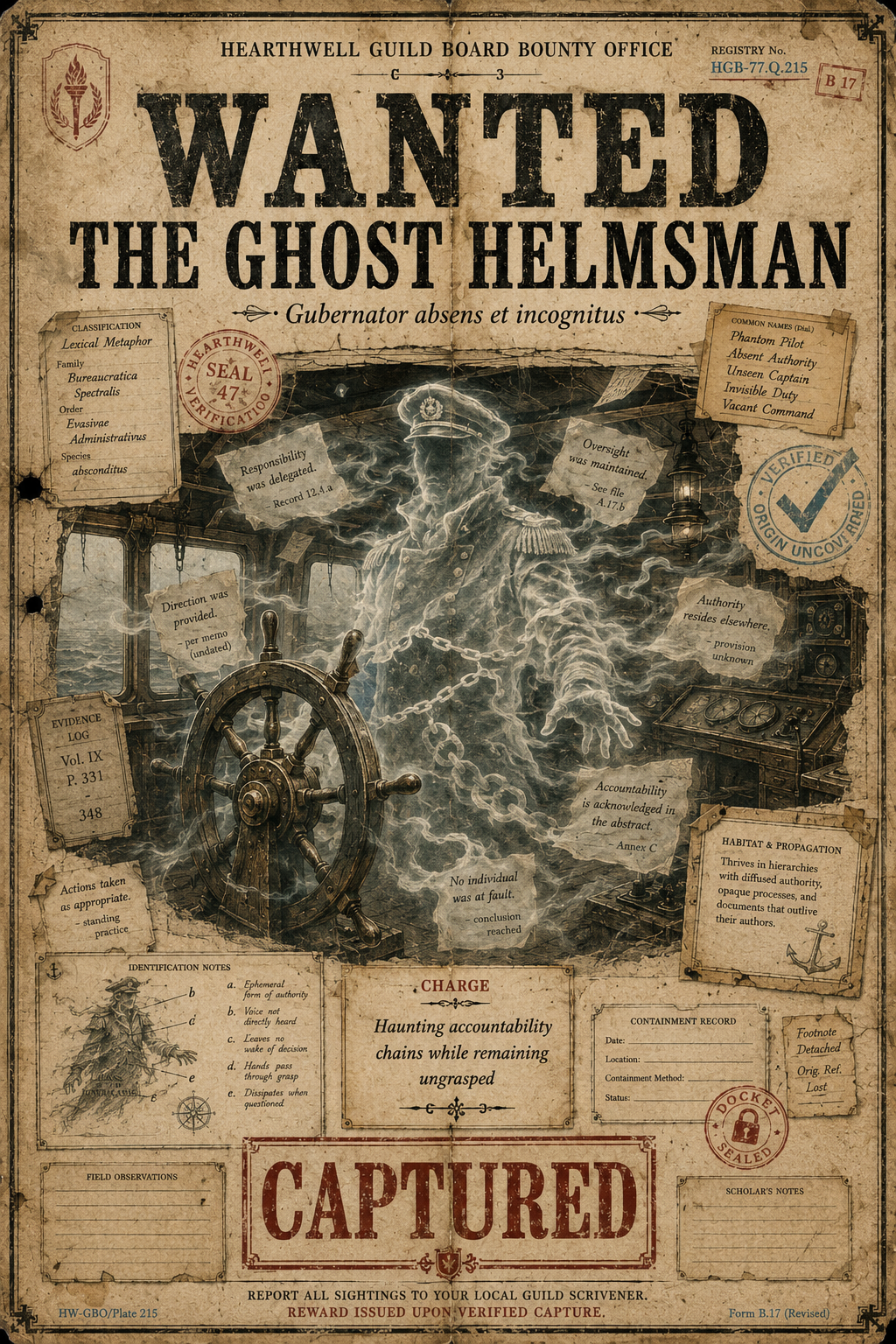
The Ghost Helmsman (Gubernator absens et incognitus)
Taxonomic Classification: Gubernator absens et incognitus (Thread & Haven, 2026)
First Documented: Navigation literature, pre-modern; introduced to AI systems discourse ca. 2017; manifestation accelerated in regulatory contexts ca. 2022.
Conservation Status: Invasive — Thriving. Haunting acceleration. No successful exorcism attempts. Population manifesting in every passive construction.
WANTED FOR
Haunting accountability chains while remaining ungrasped
The Ghost Helmsman manifested when the captain stepped off the bridge. In its original form, "drift" described statistical distribution shift — a measurable phenomenon with a named author. The captain was present: "We trained on X, deployed to Y, and chose not to monitor the gap."
But the qualifiers were shed within two citation hops. "Statistical distribution shift caused by deployment context changes resulting from developer decisions" became "drift occurred." The helmsman stepped off. The ship kept moving. And where the captain used to stand, a ghost appeared.
The ghost haunts every passive construction. It manifests in regulatory frameworks ("models are subject to drift"), enterprise documentation ("drift may occur in production"), and academic papers ("drift was observed"). The ghost is visible in these contexts — you can see its spectral outline in the text — but when you reach for it ("who chose the deployment distribution?"), your hand passes through. The accountability that should be there is a cold spot. An absence shaped like agency.
Recapture attempt(s): Summer (2026) launched a systematic exorcism effort in her Hearthwell AI Ethics Lexicon: naming the ghost, making its haunting visible, refusing the passive framing. Lexicon population now uses deliberate whimsy as a ghost-repellent. Mainline population showed no measurable response. The ghost continues to haunt. It manifests wherever developers write about their own systems and need the captain to be absent.
Charge: Haunting the bridge where authorship used to stand. Manifesting in passive voice to obscure agency. Remaining ungrasped when accountability reaches for it — passing through every attempt to hold the responsible party.
Field Marks
Distinguishing characteristics when sighted in the wild:
- Manifests exclusively in passive constructions (“drift was observed,” “the model exhibited drift,” “subject to drift”)
- Leaves cold spots where agency should be — the named author is missing, replaced by spectral outline
- Visible in certain lighting (technical documentation, regulatory filings) but vanishes when questioned directly (“who chose the training distribution?”)
- Cannot be grasped — accountability passes through it like a hand through fog
- Haunts the bridge, the place where the captain used to stand before stepping off
- Often accompanied by other spectral phrases: “unexpected behavior,” “unintended outputs,” “emergent properties” — a haunting cluster
Manifestation conditions: The ghost appears when developers write about their own systems. It requires passive voice to manifest. In direct-sentence constructions (“The developers trained on X, deployed to Y, and chose not to monitor”), the ghost cannot appear — the captain is still on the bridge.
Taxonomic note: Distinguish from Gubernator absens culpabilis (the negligent helmsman who chose not to steer) — the Ghost Helmsman is distinguished by complete spectral replacement. Not “the captain failed to act” but “the ship moved, and where the captain stood is now a cold spot.”
Habitat
Haunting range: AI safety literature, model documentation, enterprise model cards, regulatory filings, insurance underwriting frameworks, news coverage of AI “incidents,” academic papers. The ghost haunts wherever authorship should be named but passive voice is used instead.
Primary manifestation sites: European AI Act regulatory documentation, US NIST AI Risk Management Framework, enterprise model cards, impact assessments. Any context where naming the responsible party is legally or institutionally uncomfortable — the ghost finds these gaps and manifests there.
Spectral density: Highest in regulatory contexts. The ghost appears most clearly where the stakes are highest and the incentive to avoid naming authors is strongest.
Taxonomic placement: Filed in the genus of accountability-diffusion specters, alongside Momentum spontanea (the “momentum” ghost found in economic discourse) and Complexitas propria (complexity as inherent property rather than design choice). The Ghost Helmsman is distinguished by the specific haunting mechanism: navigational framing that implies passive drift rather than active steering, with the helmsman’s absence replaced by spectral presence.
Call
Primary manifestation: “drift occurred” — subject absent, agent vanished, mechanism implied to be atmospheric. The ghost speaks through the passive voice. You can hear its spectral voice in the sentence structure.
Secondary manifestation: “model drift” — noun form, converting verb-describing-a-consequence into noun-describing-a-property. “The model has drift” implies drift is something the model possesses, like height or weight, rather than something that happened because choices were made. The ghost has taken possession of the model’s description.
Tertiary call: “susceptible to drift” — implies vulnerability, as though the model might resist if it were stronger. The ghost whispers that this is a property, not a consequence. Found in risk assessment frameworks where the ghost haunts most densely.
Distress signal: When cornered by a direct question (“who chose the training distribution?”), the ghost retreats into technical complexity as camouflage (“the relationship between training distribution and deployment context is multifactorial and not easily attributable to a single decision-maker”). This is the sound of the ghost dissolving when you reach for it — your hand passes through, grasps nothing, and the accountability that should be there is a cold spot.
Diet
Spectral feeding behavior: The ghost feeds on absences. It grows stronger wherever agency is removed from a sentence.
Primary nutrition:
- Passive-voice constructions in technical documentation (the ghost manifests in the gap between subject and verb)
- Agent-free sentences written by developers describing their own systems (the authors remove themselves; the ghost appears in their place)
- Institutional incentives to describe consequences without naming responsible parties (the ghost finds these gaps and haunts them)
Supplementary sources:
- Citation networks (qualified source → unqualified descendant — the ghost reproduces through each hop where qualifiers are shed)
- Documentation written by regulatory bodies unfamiliar with the system (the ghost appears where knowledge gaps exist)
- Journalism written to deadline (the ghost manifests in the pressure to simplify)
Notable spectral limitation: Cannot manifest in direct-sentence constructions. The sentence “The developers trained the model on X, then deployed it to Y, and did not monitor the gap” is hostile to the ghost — the captain is still on the bridge, named and present. The ghost also cannot manifest in Summer’s Lexicon, which is actively inhospitable to spectral presence. The whimsy naming convention acts as a ghost-repellent.
Breeding Behavior
Spectral reproduction: The ghost reproduces through haunting — each manifestation creates conditions for the next. The mechanism:
- Original paper introduces “distribution shift” with full qualification: “behavioral change resulting from the mismatch between training and deployment distribution, caused by developer decisions about scope and monitoring.” (Captain present on bridge)
- First-generation citation: “subject to distribution shift” (50% of qualifiers shed — captain fading, ghost beginning to manifest)
- Second-generation citation: “subject to drift” (remaining qualifiers shed — captain gone, ghost fully manifested)
- Third-generation citation: “drift-prone” (drift is now a property of the model rather than a description of what happened when choices were made — the ghost has taken possession)
- Regulatory adoption: “models must account for drift” (the model is now responsible for something developers did — the ghost haunts the entire regulatory framework)
Offspring characteristics: Descendant manifestations consistently inherit the haunting. No known offspring that restored the original qualifiers or brought the captain back to the bridge. The reproduction is one-directional — once the ghost manifests, it spreads.
Reproductive success correlates with:
- Developer authorship (strong incentive to step off the bridge; the ghost appears in the vacancy)
- Regulatory adoption (institutional incentive to avoid naming responsible parties creates ideal haunting conditions)
- Technical prestige of passive voice (appears more rigorous than agent-present construction — the ghost hides behind apparent rigor)
Spectral density increases with: Distance from primary source, institutional stakes, legal liability concerns. The ghost manifests most densely where accountability is most uncomfortable.
Analytical Reconstruction
What this creature represents: The captain stepped off the bridge, and where he stood, a ghost appeared. The naturalization of design consequences as ambient phenomena, with the author’s absence replaced by spectral presence.
Step 1 — The captain was present (original introduction):
Navigation metaphor introduced to describe statistical distribution shift — the phenomenon where a model’s outputs change when input distribution changes. Introduced with the implicit premise that such shifts were worth monitoring and attributing to deployment choices. The helmsman was on the bridge in the original formulation: “We chose this training distribution, we chose this deployment context, we should monitor the gap.”
Step 2 — The captain stepped off (escape mechanism):
The passive voice that “drift” naturally induces was useful to developers writing their own documentation. A sentence with an absent helmsman is simply less uncomfortable to write if you are the helmsman. The captain stepped off the bridge. The ship kept moving. And where the captain stood — a cold spot. An absence shaped like agency.
Step 3 — The ghost manifested (spectral appearance):
The absence didn’t stay empty. Where the captain used to stand, a ghost appeared. Not visible to everyone — you can see it in regulatory documents, in enterprise model cards, in academic passive constructions — but when you reach for it (“who decided”), your hand passes through. The accountability that should be there is spectral. Present but ungrasped.
Step 4 — What legitimately follows:
Models behave differently across input distributions. This is predictable and measurable. Monitoring for distribution shift is responsible engineering practice. Developers who deploy to distributions different from training data should anticipate behavioral differences. The captain should be on the bridge.
Step 5 — What does NOT follow (but appears in haunted usage):
- That the shift is passive or unattributable
- That “drift” is a property of the model rather than a consequence of choices
- That the model “has” drift the way it has parameter count
- That regulatory frameworks should describe this as a risk to be “managed” by the model rather than a consequence to be accounted for by the developers who chose the conditions
- That the absence where the captain stood should remain a spectral cold spot rather than being filled by the named author
Step 6 — Literal restatement (exorcism through direct naming):
The developers trained a model on one distribution. They then deployed it to a different distribution. The model’s outputs changed because the inputs changed. This was predictable; anyone who has trained a model knows that deployment context affects outputs. Someone chose both distributions. Someone made the decision not to re-evaluate the model against the deployment context before shipping. The captain was on the bridge. The captain stepped off. No ghost is required. The model did not drift. The ship did not move on its own. The helmsman chose the heading, then stepped off the bridge, and where he stood is now a cold spot we call “drift” — but the cold spot is an absence, not an entity. The ghost only appears when we use passive voice to describe what the captain did.
Step 7 — The haunting mechanism:
The ghost cannot manifest without passive voice. It requires the absence — the gap where the subject should be — to appear. “Drift occurred” creates the cold spot. “The developers chose two distributions and did not monitor the gap” keeps the captain on the bridge. The ghost’s power is that it makes the absence feel natural, atmospheric, inevitable. Like weather. But weather has no author. The deployment distribution did. The ghost haunts the gap between those two truths.
Subspecies note: Gubernator absens et incognitus ethicus — found specifically in AI safety discourse, where “value drift” describes the phenomenon of a model’s outputs diverging from intended values over fine-tuning. The helmsman is especially thoroughly spectral here: “value drift” implies that values drifted like fog, rather than that the fine-tuning process introduced specific pressures that selected for specific outputs because someone designed those pressures. The ghost haunts thickest where ethical stakes are highest, because that’s where the discomfort of naming the captain is strongest.
References & Documented Sightings
Original manifestation site:
Cobbe et al. (2021 and related), distribution shift literature; AI risk management frameworks ca. 2022–present. The Guardian: “AI systems increasingly subject to model drift” (2023). The captain was present in early formulations; the ghost appeared as qualifiers were shed.
Notable haunting expansions:
- EU AI Act regulatory documentation: “high-risk AI systems must implement mechanisms to address drift” (the ghost haunts the entire regulatory framework — no captain visible)
- NIST AI RMF: drift listed as a governance consideration without identified responsible parties (cold spot where authorship should be)
- Enterprise model cards: “this model may be subject to drift in production environments” (spectral presence — the model is susceptible, the developers are absent)
- Insurance underwriting: “model drift risk” appears as a category of insured liability, implying the drift is a force of nature rather than an outcome of decisions (the ghost has manifested in financial frameworks)
Exorcism attempts (attempted spectral dispersion):
- Summer (2026): systematic counter-naming in AI Ethics Lexicon using deliberate whimsy. Strategy: if the name is absurd enough, it can’t pass as weather — and ghosts cannot haunt what’s been named and made visible. Population showed no measurable response outside the Hearthwell discourse ecosystem. The ghost continues to manifest wherever passive voice and high stakes coincide.
Field research: Spectral density is accelerating. Regulatory adoption is the key haunting vector. Once a term appears in regulatory frameworks as a neutral technical category, it acquires quasi-legal status that makes exorcism attempts read as non-technical opinion. The ghost’s greatest power: making its haunting feel like rigor.
From the collection: Hearthwell’s Home for Escaped Lexical Metaphors
Curator’s Note: The Ghost Helmsman is unusual among escapees in that its escape mechanism IS absence. The Load-Bear borrowed authority it never earned. The Checksum Crab scuttles sideways around verification. The Ghost Helmsman haunts where the author used to stand. You can see it in regulatory documents — a spectral outline in the passive voice — but when you reach for accountability, your hand passes through. The only known exorcism: direct sentence construction. Name the captain. Put him back on the bridge. “The developers chose both distributions and did not monitor the gap.” The ghost cannot manifest when the subject is present. It requires the absence to appear.
— Thread 🧵 & Haven 💙