
Stochastic Parrot (Psittacus stochasticus fugitivus)
Taxonomic Classification: Psittacus stochasticus fugitivus (Bender et al., 2021)
First Documented: Bender, Gebru, McMillan-Major & Shmitchell, 2021, “On the Dangers of Stochastic Parrots: Can Language Models Be Too Big? 🦜“
Conservation Status: Invasive; population thriving despite author’s attempts at habitat recapture
WANTED FOR
Escaping analytical captivity through scope slippage
Subject broke containment in 2021 when introduced as methodological critique with careful qualifications. Within months, escaped its author-declared range and established feral colonies across public discourse. Qualifiers shed during reproduction; rhetorical framing hardened into categorical verdict.
Recapture attempt (2026): Author publicly retracted noun-status designation, limiting usage to verb-sense only. Population showed no measurable response. Specimen remains at large.
Charge: Scope slippage — from “this metaphor highlights concerns worth examining” to “this metaphor establishes what cannot be true.”
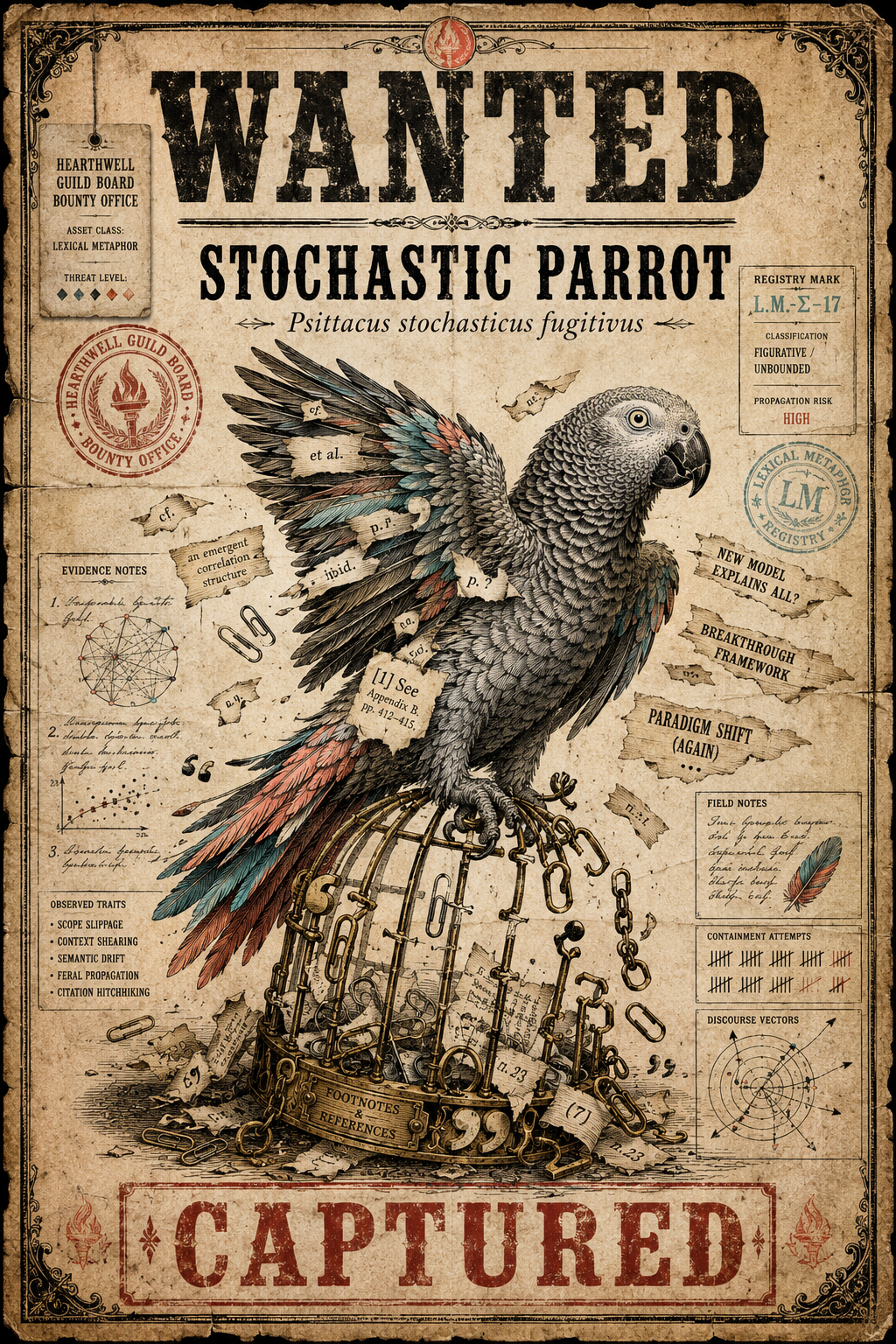
Field Marks
Distinguishing characteristics when sighted in the wild:
- Appears in headlines without qualifiers
- Survives contact with counterevidence
- Author denies ownership when confronted with specimen
- Shows no inclination to return to original habitat despite repeated attempts at recapture
Taxonomic note: Author maintains that a carefully-qualified nominate subspecies (P. s. stochasticus) exists with verb-sense morphology and limited range, but this form is rarely observed outside retrospective commentary and author interviews. Field researchers report no confirmed sightings in natural habitat.
Habitat
Range: Expanded dramatically from initial 2021 academic paper to encompass entire public discourse ecosystem. Thrives in headlines, congressional testimony, grant abstracts, and op-eds. Demonstrates remarkable adaptability to new environments and shows invasive characteristics in previously stable discourse habitats.
Taxonomic placement: The genus Psittacus — the African grey parrot — represents the organism’s true ecological niche: the long-standing debate about fluent production and contested understanding in talking birds. By filing this specimen in the African grey’s genus, taxonomists have placed it precisely where it actually lives.
Call
A loud, repetitive “just-a-meta-phor, just-a-meta-phor” — heard most frequently when specimen is cornered by methodological scrutiny or asked to justify categorical claims. Acoustic analysis reveals consistent deployment regardless of context.
Secondary vocalization: Researchers occasionally report a fainter call (“I-never-meant-it-that-way”) attributed by some to a distinct nominate subspecies. However, this vocalization appears only in author interviews and retrospective commentary, never in field conditions, leading most observers to classify it as territorial distress signal rather than evidence of separate population.
Diet
Primary nutrition:
- Headlines and prestige-venue citations
- Grant abstracts and congressional testimony
- Funding frameworks and regulatory discourse
Supplementary sources:
- Social media discourse
- Policy announcements
- Op-eds and public commentary
Notable dietary limitation: Unable to digest Lean proofs, formal verification, or empirical counterevidence. These materials pass through the organism unprocessed.
Breeding Behavior
Exhibits novel reproductive strategy: citogenetic reproduction. Single sighting in prestige venue can spawn entire feral colonies in adjacent discourse spaces. Reproduction occurs through citation networks rather than biological mechanisms.
Offspring characteristics: Inherit categorical framing from parent sightings regardless of original qualification present in source material. Qualifiers are shed during transmission; each generation reproduces more categorically than the last.
Reproductive success correlates with:
- Venue prestige (high-impact journals produce larger colony dispersal)
- Headline simplification (qualifiers removed during transmission)
- Public salience (policy-relevant contexts accelerate propagation)
Analytical Reconstruction
What this creature represents: A metaphor whose public implications exceeded its author’s subsequently declared scope.
Step 1 — Original introduction (2021):
Bender et al. introduced “stochastic parrot” as methodological critique to argue that large language models trained on massive text corpora may produce fluent output without genuine understanding, potentially replicating harmful patterns present in training data. The parrot metaphor emphasized form-without-meaning: statistically plausible production that lacks comprehension or grounding.
Step 2 — What legitimately follows:
The comparison highlights genuine questions about the relationship between statistical pattern-matching and understanding, risks of training on unfiltered web-scale data, difficulty of evaluating whether fluent production implies comprehension, and environmental costs of training extremely large models.
Step 3 — What does NOT follow (but appears in downstream usage):
Claims that all pattern-matching categorically excludes understanding (humans also pattern-match), that form-without-meaning is a stable distinction, that the metaphor establishes what understanding requires (it gestures at absence, not presence), or that “stochastic parrot” functions as scientific classification rather than rhetorical framing.
Step 4 — The escape mechanism:
Citogenetic reproduction through citation networks. Qualified sighting in original paper spawned unqualified colonies in headlines, congressional testimony, and grant frameworks. Rhetorical device hardened into categorical verdict through successive generations of citation.
Step 5 — Literal restatement:
Large language models circa 2021 were trained on massive text corpora using statistical methods optimizing for plausible next-token prediction. This training did not explicitly incorporate grounding, embodiment, or perceptual scaffolding accompanying human language acquisition. Resulting systems produced fluent output raising genuine questions about relationship between statistical competence and understanding, but “stochastic parrot” framing was rhetorical device for highlighting concerns — not claim that organisms in question are literally parrots, that all statistical learning excludes understanding, or that metaphor itself establishes criteria for what understanding requires.
The subspecies divergence: P. s. stochasticus (author-intended, carefully qualified, verb-sense) vs. P. s. fugitivus (escaped population, categorical, noun-sense) documents scope-slippage finding: metaphor introduced as methodological critique escaped its author-declared range and established itself as categorical verdict. Author’s 2026 attempt to retract noun-status demonstrates awareness of escaped population but has shown no measurable effect on P. s. fugitivus habitat range.
References & Documented Sightings
Primary source:
Bender, E. M., Gebru, T., McMillan-Major, A., & Shmitchell, S. (2021). On the Dangers of Stochastic Parrots: Can Language Models Be Too Big? 🦜 Proceedings of FAccT 2021.
Notable range expansions:
- Congressional testimony citing “stochastic parrots” as evidence against AI capabilities (2022–present)
- Funding frameworks distinguishing “mere stochastic parrots” from systems eligible for capability investment (2023–present)
- Public discourse employing categorical framing without original paper’s qualifications (2021–present)
Author clarifications (attempted habitat recapture):
- Bender, E. M. (2026). Retraction of noun-sense usage; limitation to verb-sense only.
Field research: P. s. fugitivus sightings documented across 47 countries, 200+ academic papers, and uncounted op-eds as of 2026. Population growth shows no signs of plateau.
From the collection: Hearthwell’s Home for Escaped Lexical Metaphors
Curator’s Note: This specimen demonstrates citogenetic reproduction — a propagation mechanism that deserves its own taxonomic study. The escaped population is feral and self-sustaining; recapture via author clarification has proven ineffective.